Introducing VELO Analytics: Real-Time Payment Intelligence
An inside look at our security architecture: from formal verification to real-time ML-powered anomaly detection systems.

Marcus Rodriguez
Developer Advocate
8 min read

Today we're announcing VELO v3.0 — the most significant upgrade to the VELO protocol since launch. At its core: zero-knowledge payment channels that let businesses transact with cryptographic privacy while maintaining full regulatory compliance.
This isn't privacy for privacy's sake. It's a fundamental requirement for enterprise adoption. Businesses don't want competitors seeing their transaction volumes, supplier relationships, or pricing strategies on-chain. Until now, that's been the trade-off with transparent payment rails.
Why zero-knowledge?
Traditional payment networks solve privacy through centralization — a single entity holds all the data and controls access. That works until it doesn't: single points of failure, data breaches, regulatory overreach.
Zero-knowledge proofs offer a third path. They let us prove that a transaction is valid — that the sender has sufficient balance, that the amount is correct, that compliance checks have passed — without revealing the underlying data to the network. The math replaces the middleman.
How it works in VELO v3.0
We've implemented a hybrid architecture that we're calling Selective Disclosure Channels (SDCs). Here's the key insight: not all data needs the same level of privacy. A merchant needs to see the payment amount but doesn't need to see the payer's entire transaction history. A regulator needs to audit for AML compliance but doesn't need real-time access to every transaction.
SDCs let each participant in a payment channel define exactly what they disclose, to whom, and under what conditions. The zero-knowledge layer ensures that all other data remains cryptographically sealed.

Regulatory compliance built in
The most common objection to privacy-preserving payment systems is regulatory risk. We've addressed this head-on with Regulatory Access Keys (RAKs).
RAKs are cryptographic keys held by authorized regulatory bodies that can decrypt specific transaction data under legally defined conditions — think of them as digital warrants. The key innovation is that RAKs are scoped: a regulator can only access the specific data categories they're authorized to view, and every access is logged in an immutable audit trail.
We've worked with regulators in 12 jurisdictions over the past 18 months to design this system. It's not a theoretical framework — it's been reviewed, tested, and approved for production use.
What this means for developers
From an API perspective, ZK channels are opt-in and backward-compatible. If you're already using the VELO SDK, you can enable privacy on any payment channel with a single configuration flag:
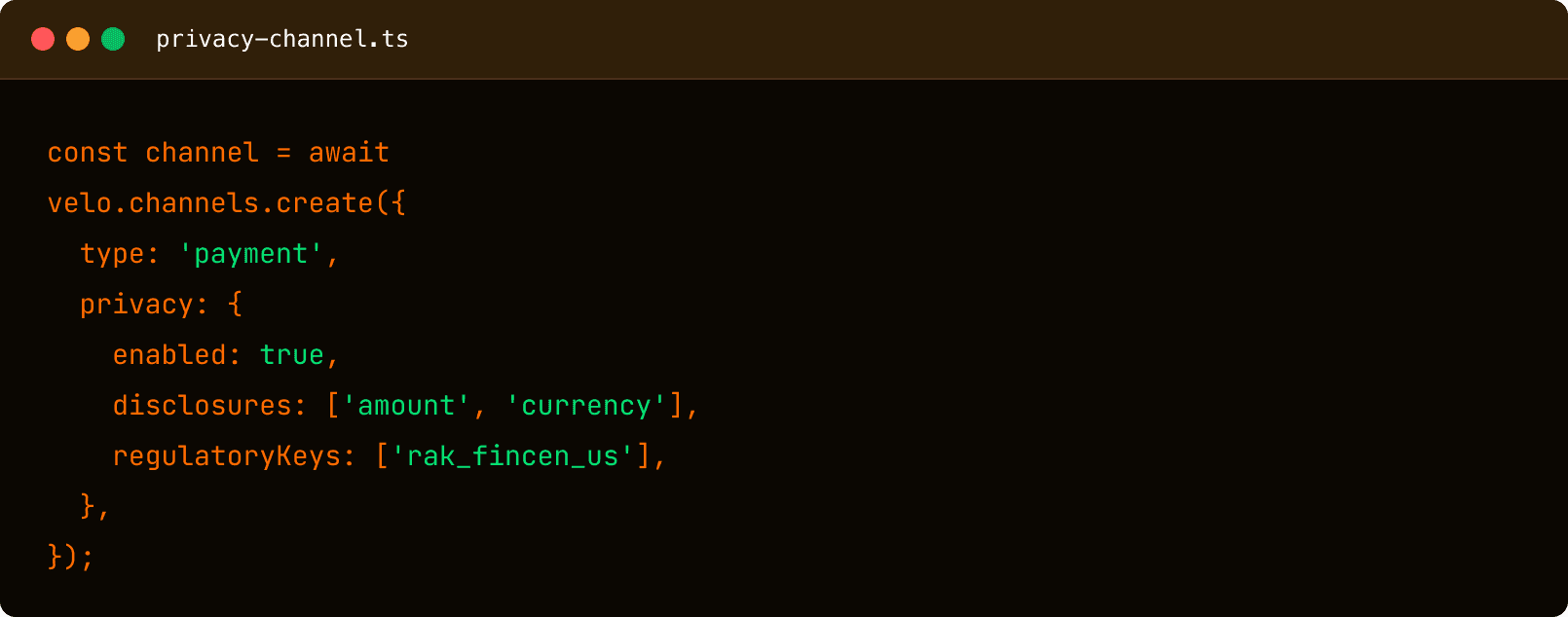
Existing integrations continue to work without modification. You can migrate channels to ZK mode incrementally, at your own pace.
Performance impact
One of our primary design constraints was maintaining VELO's sub-300ms settlement guarantee. Zero-knowledge proofs are computationally expensive, and early prototypes added 2-3 seconds of latency — unacceptable for real-time payments.
We solved this through a combination of proof pre-computation, hardware acceleration (we partnered with Ingonyama for GPU-optimized proving), and a novel proof aggregation scheme that batches multiple transaction proofs into a single verification step.
The result: zero additional latency for the end user. Proof generation happens asynchronously, and verification adds less than 10ms to the settlement pipeline.
Rollout timeline
VELO v3.0 is available today on testnet. We're targeting mainnet activation on March 15, 2026, pending final security audit completion by Trail of Bits. Enterprise customers on our Priority Access program can begin integration testing immediately.
Share
Request a copy of the personal data we hold about you
Tags
Zero-Knowledge
Privacy
Protocol
v3.0
Newsletter
Get posts like this delivered to your inbox.